
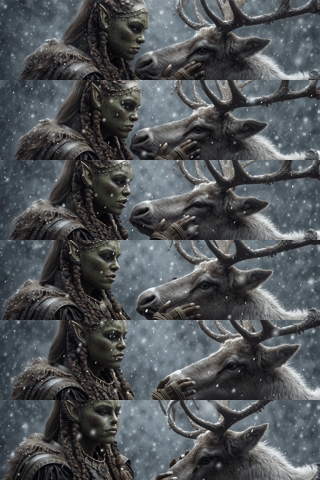
Ofloruk orc tribe
The Ofloruk orc tribe is the currently the strongest reindeer herding orc tribe roaming the the Great Colassian Tundra.
They are able to hold their own and even thrive while other reindeer orc reindeer herders have declined largely because they have a higher proportion of powerful spell-casters than most.
Culture
Shared customary codes and values
Most of the reindeer herding orcs worship Nami and Maylar pretty exclusively. The Ofloruks worship Greymoria and Korus primarily, but they still honor Maylar and Nami.
While these are the big four, they worship the totality of the the Nine to a limited extant, at least more than most other orcs do. This is partially why the tribe's leadership and the tribe as a whole seems to be more versatile and better at problem solving and negotiation than other orcs tribes since they don't use "fight or flight" as their only options all the time.
Common Etiquette rules
"Civilized men are more discourteous than barbarians because they know they can be discourteous without having their heads caved in" - Robert E. HowardIn most orc tribes, might makes right, and this is more or less true in the Ofloruk tribe, but since the tribe has so many mages theurgists, you can't always tell who is strongest by seeing who has the biggest muscles. This means that the Ofloruks are surprisingly soft spoken and civil, at least compared to other orcs. They are also more cautious with outsiders. They are aware that when dealing with humans, satyrs, or even gnomes, you can't always tell who is strong by looking at them. While they are generally polite, they value honesty. The Ofloruks tend to speak directly and brusquely without coating their words in honey.
Common Dress code
The Ofloruks geberakkt dress for the elements and not for fashion. They wear simple leathers and furs because that is what is most practical. Though they are not completely averse to status conscious clothing.
When they trade with (or steal from) humans, wool is often sought after. Wool cloaks considered functional and somewhat of a status flex.
Foods & Cuisine
The Ofloruks are very skilled hunters and foragers and can find food almost anywhere, but their major staple is reindeer meat and reindeer cheese.

Common Customs, traditions and rituals
The tribe as a whole is split into different clans and each clan has a chief.
Tribal leaders can be men or women, but they are always warlocks of Greymoria unless a clan doesn't have a living warlock available in which case an interim priest or priestess is selected until a suitable warlock can be found from another tribe willing to step in.
Warlocks can challenge the clan chief formally on any full moon. These challenges are violent but rarely to the death unless a warlocks keeps making several failed challenges in succession in which case all bets are off.
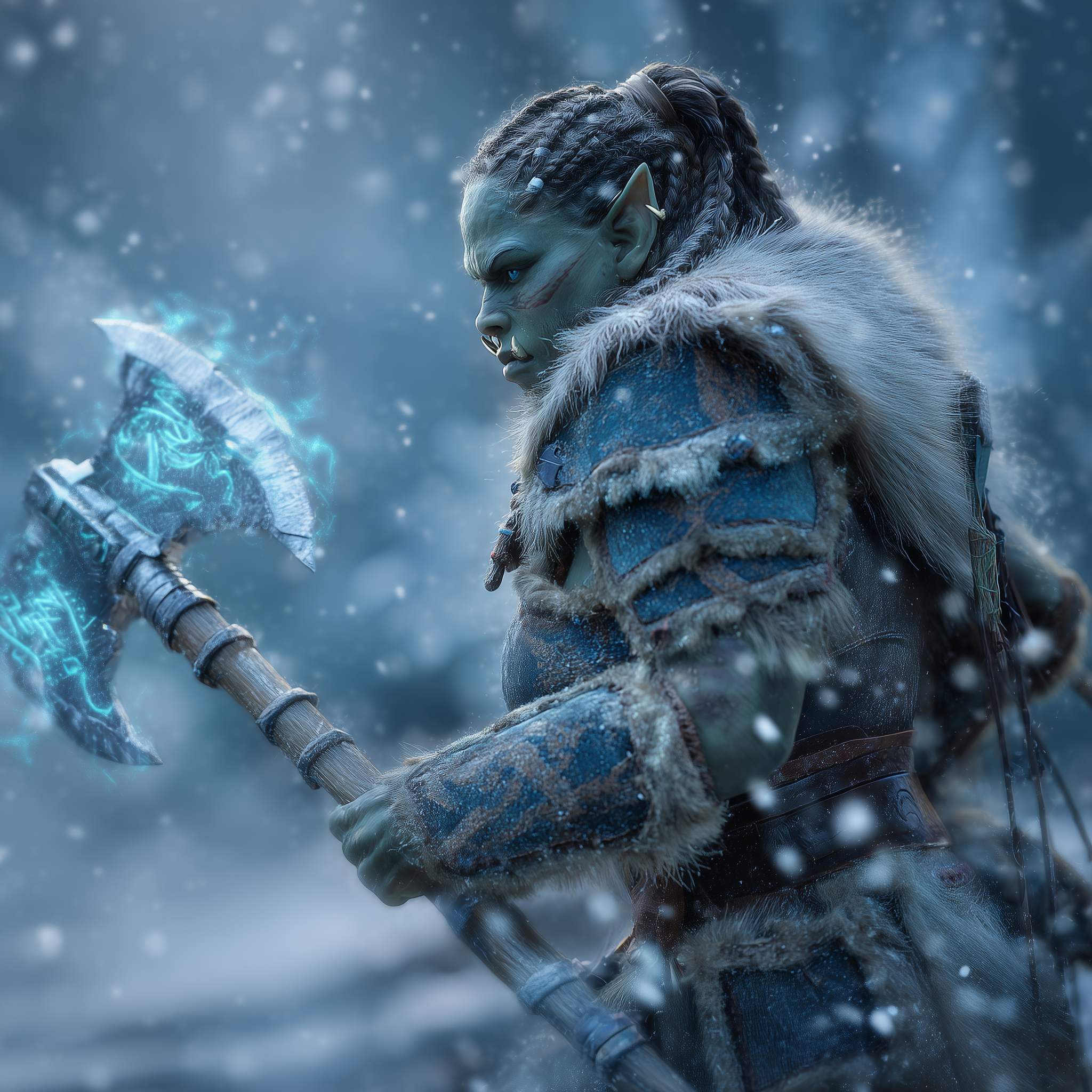
by me with Midjourney
Birth & Baptismal Rites
Parents usually pick a boy name and girl name before the child is born and they share their preferred names with the tribal elders.
After nine days have passed, an infant is presented to the elders and the elders determine whether they child is healthy enough to join the tribe or is killed as a mercy. This is mostly a formality. Weak or sickly looking children are often put down by their own family before they are formally presented.
Assuming the infant passes, the elder will shout "By all the Nine all our honored ancestors we welcome _________ into the clan!" The onlookers roar in approval and the baby probably cries from all the noise. A loud crying baby is viewed as a positive sign of health and future strength.
Coming of Age Rites
Adolescent orcs (both boys and girls) go on a vision quest or take on a personal challenge dictated by a priest, priestess, or spirit loa dictated by a spirit messenger of one of the Nine or one of the tribe's honored dead.
The exact trial varies from person to person based on the whims of the spirits (or the whims of the elder claiming to talk to the talk to the spirit). Climbing a mountain is common. Ceremonial hunts are common. Tests of endurance are common.
If a young orc fails (and lives to tell about it), they can attempt a new trial next year. If they fail a second time, they can undertake a new trial the third year, but it's going to be very difficult. If the third trial doesn't kill them, three-time failures are not welcome back in the tribe.
Assuming a rite of passage is successful (most are), the young orc chooses a name or title or they are given one. They do not lose their original name. Adults have two names. The first is their earned name, and the second is their childhood name. It is not normally considered insulting to refer to an adult by their childhood name, even if the person didn't know them well as a child.
Funerary and Memorial customs
The Ofloruks take their remembrance days for the dead very seriously and they take pride in their mighty ancestors. As a result they have proportionally more spirit loas than most other orc tribes.
All activity stops for major remembrance holidays, but actual funerals are pretty short and simple. They don't want to leave their dead to be eaten by scavengers, but funerals are not very elaborate. They don't waste precious firewood on cremations and they don't normally include burial goods, not hesitating to reappropriate the deceased person's best clothes and possessions among the living.
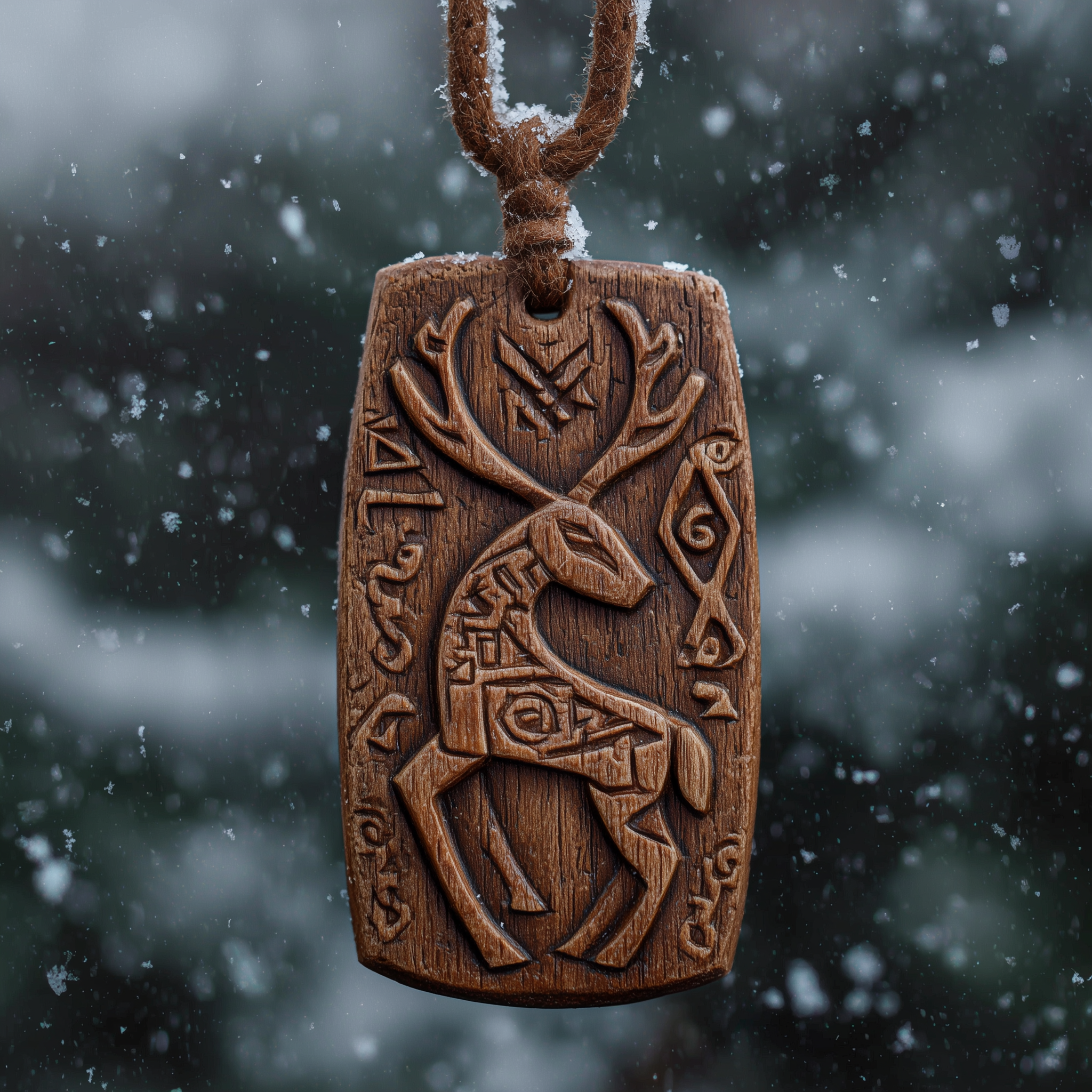
Young orcs receive a wood carved pendant from their parents on their third birthday. They carve another pendant shortly before or after their rite of passage. These wood carvings are pretty much the only burial goods a deceased is interred with.
by me with Midjourney
Common Taboos
The tribe has no tolerance for cannibals and will go out of their way to hunt wendigos from other tribes.
Eating reindeer meat and cheese is common, but eating the flesh of mil of a giant reindeer is extremely a serious insult to Korus and the rest of the Nine.
Historical figures
The Ofloruks claim descent from Mogak the orc heroine (though pretty much all reindeer herding orcs make the claim). They claim this is why they have not stopped worshiping Nami even though they now see Greymoria as their primary divine patroness.
Oflorah, supposedly a direct descendant of Mogak, took over the tribe during a time of turmoil.
Oflorah was a powerfulGreymoria empowered warlock, but she was surprisingly diplomatic and open to compromise for a staunch Greymoria worshiper. She took over the tribe only after assuring the full backing of several Korus priests and priestesses and a handful of other priests and priestesses.
Oflorah had some several children, about half of which became warlocks. She also mentored warlocks outside of her bloodline and the tribe became known by other tribes as "the one with all the warlocks."
Ideals
Beauty Ideals
Most Ofloruk orcs are light gray. A few are different colors with dark gray and green being hardly unheard of, but different colored orcs are not considered ugly or inferior.
Among men and women, being tall and lithe is considered attractive. Being muscular is also viewed as being attractive, but it's not overtly important as it is with other orc tribes.
Men and women alike tend to wear their hair long and often braid their hair.
Courtship Ideals
The Ofloruks are concerned with inbreeding issues and clans exchange marriage partners fairly often. The Ofloruks break the usual orc mold and are matrilineal with young male orcs joining their wife's clan rather than the other way around.
Relationship Ideals
The Ofloruks normally practice monogamy, though warlocks, priests, and priestesses might sometimes have a second or third spouse.
Widows and widowers face a lot of social pressure to remarry if they are still of childbearing age.
Encompassed species
Related Locations

Comments