

How far can characters travel over land in a single day?
As a Game Master, very frequently I have PCs and NPCs arrive "at the speed of plot". They arrive or don't arrive based on the needs on the story.
Sometimes, this isn't good enough, and a concrete number is called for. Based on the work of Medieval History TV, I am applying the historical precedent to Scarterra that a normal travel distance for a normal person on foot on a normal road in one day is going to be about 15 miles, give or take.
Medieval Earth travelers didn't camp much and Scarterrans are much the same. In civilized lands, inns and inn-equivalents are normally spaced out at roughly 10 to 20 mile increments and travelers will hopscotch from one inn to the other on their itineraries.
There are mitigating factors: high quality road versus a low quality road. A heavy load versus a light load. Good weather versus bad weather, seasonal variations in daylight etc, but there is slack built in. If travelers enjoy optimal travel conditions, they will probably arrive early and have more time to relax at the in. It's rare for Scarterran travelers to try to push their luck and head to the next inn.
If travelers have suboptimal travel conditions, they will probably arrive late and utterly exhausted, but they are not going to stop before reaching the inn unless truly desperate.
What if the travelers have cargo? A strong, athletic person can push a hand cart full of wares fifteen miles without a whole lot of problems, assuming the weather is reasonable. A sturdy mule or draft horse can pull a loaded cart fifteen miles in one day even with inclement weather. In both cases, they are still going to want to stay at inns rather than camp by the road (though a cart or wagon makes a good improvised shelter).
If a traveler is fortunate enough to have a good riding horse or even better, a team of solid carriage horses, he or she might opt to travel 30 miles a day and go past two inns. This is certainly doable, but it's often the case that these travelers choose to still only travel 15 miles a day.
This puts less strain on their horses, and lets travelers take their time at their destinations. A traveling musician has more time to play music if she arrives early. A traveling merchant has more time to sell his wares if he arrives early. A circuit priest has more time to proselytize if he arrives early.
A very skilled rider with a very good horse can go farther. A top tier professional messenger might reasonably be expected to travel roughly 45 miles a day going past three inns.
For context, the fastest overland travel in real world history was the Pony Express. Messengers could travel over 200 miles a day but these riders swapped out their horses for fresh horses every 10 to 15 miles. The level of logistical support needed to change out horses like this just doesn't exist in Scarterra. At best, a royal messenger might be able to swap out horses once a day, but only when traveling in their liege's territory.
And all that's assuming that the party is not bothering to avoid patrols, hide their tracks, or stopping to hunt and forage. Those things all require additional rolls and will reduce the distance a party can realistically travel.
 A dragon or chimera might be able to carry a human rider or equivalent 60 to 75 miles a day for many days on end though very few dragons or dragon-like creatures will consent to play horsey like this.
Assuming you have someone who can't naturally fly but has access to the Fourth Circle spell "Overland Flight" or the equivalent with Air Theurgy, roughly 50 miles a day (three inns) is considered a reasonable amount of flying.
Magical flight is not effortless. A days travel flying is roughly as physically taxing as a day's travel walking. Whether flying with magic or flying with wings, Scarterran flyers normally have to take a short break roughly every two hours and this requires landing making long flights over water problematic.
Without GPS, landmarks, or road signs, a flyer is even more likely to get lost than a traveler on foot. To navigate successfully, a flyer needs to make an Intelligence + Survival roll with a variable difficulty based on how familiar the navigator is with the area and how many landmarks are visible from the sky.
One success means you took the "scenic route" to your destination. Three successes assumes you fly over roads over other obvious landmarks such as rivers. Five successes you manage to get from point A to point B more or less by a straight line. A botch means you fly a good ways in the wrong direction or encounter some kind of hazard or obstacle.
Naturally flying creatures have better instincts and more relevant experience for aerial navigation than groundlings. Dragons, zotz and other intelligent flyers receive -1 difficulty on rolls to navigate by air.
A dragon or chimera might be able to carry a human rider or equivalent 60 to 75 miles a day for many days on end though very few dragons or dragon-like creatures will consent to play horsey like this.
Assuming you have someone who can't naturally fly but has access to the Fourth Circle spell "Overland Flight" or the equivalent with Air Theurgy, roughly 50 miles a day (three inns) is considered a reasonable amount of flying.
Magical flight is not effortless. A days travel flying is roughly as physically taxing as a day's travel walking. Whether flying with magic or flying with wings, Scarterran flyers normally have to take a short break roughly every two hours and this requires landing making long flights over water problematic.
Without GPS, landmarks, or road signs, a flyer is even more likely to get lost than a traveler on foot. To navigate successfully, a flyer needs to make an Intelligence + Survival roll with a variable difficulty based on how familiar the navigator is with the area and how many landmarks are visible from the sky.
One success means you took the "scenic route" to your destination. Three successes assumes you fly over roads over other obvious landmarks such as rivers. Five successes you manage to get from point A to point B more or less by a straight line. A botch means you fly a good ways in the wrong direction or encounter some kind of hazard or obstacle.
Naturally flying creatures have better instincts and more relevant experience for aerial navigation than groundlings. Dragons, zotz and other intelligent flyers receive -1 difficulty on rolls to navigate by air.
Armies on the March
Unlike a normal travelers, armies do not have to hop from inn to inn, and an inn couldn't hold an army anyway. Unlike civilians, medieval armies did set up camp regularly. On average, a medieval army is still going to usually be able to march about 10 to 20 miles per day. There are more mitigating factors for an army on the march than for most peacetime travelers. The average soldier is stronger and tougher than the average peasant traveler. Based on this, you'd think a soldier could average more miles per day than the average civilian, but armies on the march typically have long baggage trains and have to carry weapons, armor, and others supplies that traveling peasants normally don't have to contend with. Also, if the army digs in and fortifies every campsite, this will take time and energy, so they won't be able to cover ground as fast. Under ideal conditions, an elite military unit that is relatively lightly equipped might be able to cover 40 miles in a day. At the other extreme, an army dragging heavy equipment through muddy fields might only manage to cover 5 miles a day.
Off-road travel
Off-road travel is harder and it depends heavily on the skill and hardiness of the travelers with a dash of luck thrown in. To figure out how far a group can go, take the character with the highest Survival rating in the party. Then take the character in the party with the lowest Stamina rating. And add that Stamina and Survival. The party can travel five miles plus two miles per success rolled. A botch means something really bad happens.Stamina+ Survival difficulty
Typical Rural lands/light woods 5 Medium Forest, moderate hills 6 Thick Jungle, steep mountains 7 Inclement Precipitation +1 Cold/hot +1 Rationing food/water +1 Group is more than ten people +1 Area is unfamiliar and/or poorly mapped +1 Are is very familiar to the navigator -1 The party has utilitarian magic to make travel easier -1Flyers
"It's a simple question of weight ratios. A five-ounce bird could not carry a one pound-coconut. Monty Python and the Holy GrailNatural flyers can travel very far in a single day, but their travel distance is greatly reduced if they are carrying something even moderately heavy. Winged humanoids such as kalazotz and camazotz are not nearly as efficient at flying as regular birds and bats are.
If carrying very little (less than a tenth her body weight), a kalazotz would consider flying 45 miles in a single night reasonable. She would consider 15 miles a night reasonable if carrying a fairly heavy load (max half of her body weight). A zotz can push herself and cover a lot more distance in one night, but not every day. After flying extra far, she is going to have to take an extra long rest.
A pegasus or other loose equivalent to a flying horse can cover about 45 miles a day (three inns) while carrying an armored rider every day for many days on end. Again, like with the zotz, a pegasus can fly even farther than that in a single day if they are prepared to take an extra long once reaching their destination. Without carrying anything, pegasi and similar fantastical creatures can travel hundreds of miles in a single day.
Commissioned kalazotz flying, grey background by Diana Rahfoth
Game Masters, don't go crazy with Fatigue checks
At first glance, Fatigue check ruless are pretty strict. Using the rules, you can easily roll 3 to 4 times (or more) per character per day. On a a very long journey with five PCs can easily turn into hundreds of dice rolls which can become very tedious. Game Masters should only call for Fatigue checks at dramatically appropriate times, not every time a character might be tired. Even when traveling through fairly dangerous places, most days traveling are uneventful, so it doesn't really matter how well or how poorly you rolled on fatigue checks. On a good day, the travelers arrive at their inn cheerful and energetic. They probably stay up late chatting the locals at a tavern. On a bad day, characters arrive tired and grumpy and probably go straight to bed. You don't need to roll this out, just assume characters on a journey have a mix of good days and bad days. As a Game Master, you should only make travelers make Fatigue checks when something unusual is happening on the road or at their destination. If the player characters are going to get attacked by bandits on Day 7 of a 12-day journey, than you only need to roll Fatigue checks on Day 7,. That way you know how alert and well-rested the characters will be when the attack comes.

by me with Midjourney
What about little guys?

by Zeta Gardner
Spirit Steeds
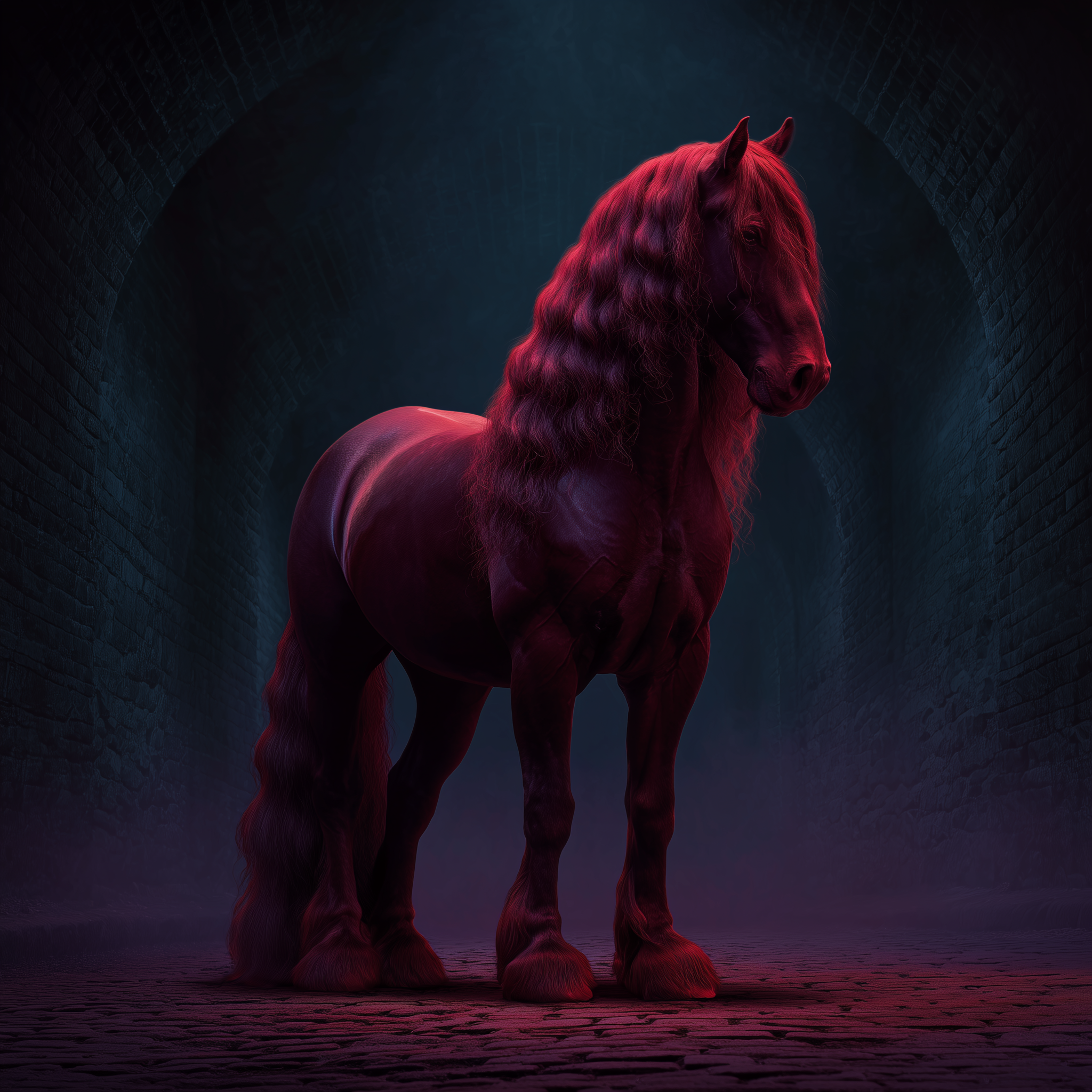
by me with Midjourney

Comments